

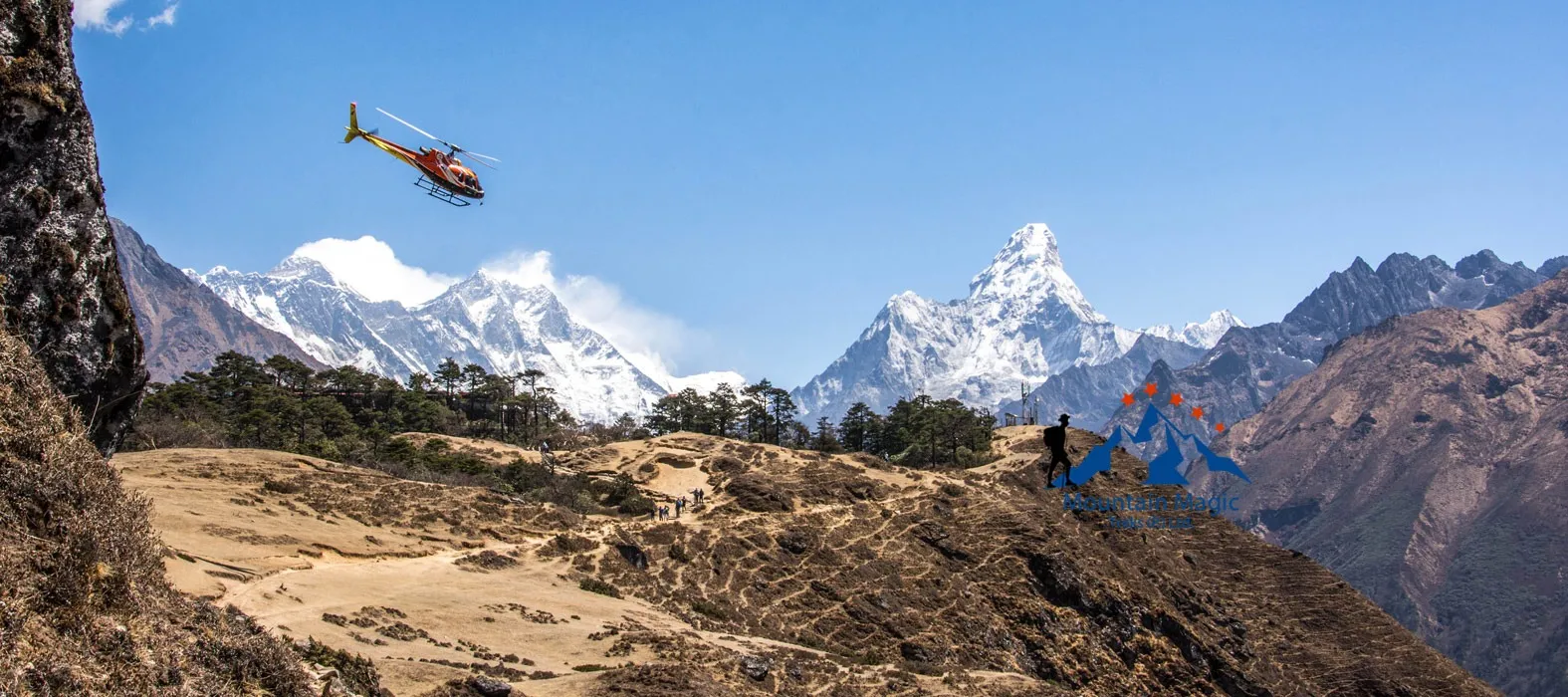
There is a big difference between seeing Mount Everest from a plane and walking toward it step by step. On a trek, the mountain slowly becomes part of your day. You pass small villages, walk beside rivers, climb stone paths, and watch the landscape change as you gain height.
The Everest Base Camp Trek With Helicopter Return adds a different ending to that experience. You still make the journey to Everest Base Camp on foot, but you do not have to walk the same trail all the way back. After reaching the high point of the trip, you can return by helicopter and see the Khumbu region from the sky.
According to the trip details, the journey is planned for 10 days and includes acclimatization stops at Namche Bazaar and Dingboche. The highest point is Kala Patthar at about 5,545 meters.
The Journey Starts Long Before Base Camp
The first days are not about rushing toward Everest. They are about getting used to the mountains.
The route begins around Lukla and moves through the Khumbu region. From there, the trail leads toward places such as Phakding, Namche Bazaar, Tengboche, Dingboche, Lobuche, and Gorakshep.
Each village feels a little different.
Life Changes as You Climb
Lower sections of the trail can feel lively and green. You may walk through forests and see rivers running below the path.
Higher up, trees become fewer. The air feels colder, the trail becomes more rocky, and the mountains seem much closer.
This gradual change is one reason the trek feels so rewarding. You do not simply arrive in an extreme mountain landscape. You slowly enter it.
Namche Bazaar Is More Than a Rest Stop
Namche Bazaar is one of the most important places on the route.
It sits high in the Khumbu and is surrounded by steep mountain slopes. Trekkers often spend time here to let their bodies adjust before climbing higher.
You may use the free time to walk around the village, visit local shops, enjoy a warm drink, or simply look at the mountains.
Why Acclimatization Matters
At high altitude, your body needs time to adjust to lower oxygen levels.
That is why the itinerary includes acclimatization at Namche Bazaar and Dingboche. The goal is not to make the trek longer for no reason. It gives your body a better chance to handle the higher sections of the route.
Do not confuse acclimatization with a rest day at home. You may still walk during these days, but the pace is usually easier.
Tengboche Brings a Different Side of Nepal
The trail also passes through Tengboche, a well-known mountain village with a Buddhist monastery.
The experience here is different from simply looking at peaks. Prayer flags, Buddhist traditions, and local mountain life become part of the journey.
For many trekkers, this cultural side makes the Everest region feel more personal.
You are not walking through an empty mountain range. People live, work, worship, and travel here.
The Final Walk to Everest Base Camp
The landscape becomes much harsher as you move toward Gorakshep.
The green hills are mostly gone. Rocks, snow, glaciers, and massive peaks take over the view.
From Lobuche, the route continues toward Gorakshep before the walk to Everest Base Camp. The trip information lists the base camp at around 5,364 meters.
Reaching the Khumbu Icefall
Everest Base Camp is not the summit of Mount Everest.
It is the staging area used by climbers preparing for expeditions on the mountain. From the area, you can see the huge Khumbu Icefall and surrounding peaks.
Standing there after days of walking feels different from seeing Everest in a photograph.
You know how much ground you covered to get there.
Kala Patthar Gives You Another View
The trek does not end with Base Camp alone.
Kala Patthar is another major point of the journey and reaches about 5,545 meters according to the itinerary. From this high viewpoint, trekkers can get close views of Everest and other major peaks such as Pumori, Lhotse, and Nuptse.
For many people, this is one of the strongest mountain-view moments of the entire trip.
The early morning light can make the peaks look completely different from the way they appeared the day before.
Then the Helicopter Changes Everything
After spending days walking uphill, suddenly looking at the mountains from a helicopter is a strange feeling.
The trail that took hours to cross becomes a thin line below you.
A Everest Base Camp Trek With Helicopter Return is designed to remove the need to retrace the entire route on foot. The listed plan has the helicopter pickup around Gorakshep before the flight toward Kathmandu.
Look Down Instead of Looking Up
During the trek, your eyes are usually focused on the trail ahead.
Inside a helicopter, you can look down.
You may see glaciers, valleys, villages, rivers, forests, and mountain ridges from a completely different angle. The flight turns the return journey into another sightseeing experience rather than simply a way to get home.
Weather still matters, though. Mountain flights can be affected by wind, cloud, and visibility, so the exact flight timing can change.
Who Will Appreciate This Style of Trek?
This trip can make sense for people who want the full trekking experience but cannot spend many extra days walking back.
It may suit:
-
Travelers with limited vacation time
-
People who want to reach Everest Base Camp on foot
-
Trekkers who prefer not to repeat the same trail
-
Travelers interested in aerial Himalayan views
-
Couples, families, or small groups looking for a different Everest trip
But there is one thing you should not misunderstand.
A helicopter return does not turn this into an easy trip.
The walking portion remains physically demanding, and the route reaches very high altitude.
Choosing the Right Season
Spring and fall are popular periods for this journey because the weather is often more favorable for trekking and mountain views.
The trip page lists February to May and September to December among its preferred months.
Still, mountain weather does not follow a perfect calendar.
A clear morning can change quickly. That matters even more when a helicopter flight is part of your return plan.
What Makes This Journey Worth Remembering?
The best part may not be one single landmark.
It could be the first sight of a giant peak above Namche. It could be walking through Tengboche. It could be the silence near Gorakshep. Or it could be seeing the trail disappear below you during the helicopter ride home.
That is what makes the Everest Base Camp Trek With Helicopter Return different from a simple sightseeing trip.
You experience Everest at walking speed first.
Then you see it from the air.
Conclusion
The Everest Base Camp Trek With Helicopter Return offers a useful balance for travelers who want a genuine Himalayan trek without spending several extra days retracing the same path.
You still walk through Sherpa villages, adjust to high altitude, reach Everest Base Camp, and climb toward Kala Patthar. The difference comes at the end, when the helicopter turns the return journey into an aerial view of the mountains you have just crossed.
It is not the easy way to Everest.
It is a different way to finish the journey.
FAQs
How many days is the trek?
The listed trip is designed as a 10-day journey from arrival in Kathmandu through the trek and return.
What is the highest point?
Kala Patthar is listed at about 5,545 meters, making it the highest point of the itinerary.
Do I still trek to Everest Base Camp?
Yes. The helicopter is used for the return portion, while the main journey to Base Camp is completed on foot.
Where does the helicopter return begin?
The listed itinerary describes pickup around Gorakshep before the flight toward Kathmandu, although the exact operation can depend on weather and flight conditions.
Is the trek physically difficult?
Yes. The trip is rated moderate to strenuous, with several days involving roughly 6–7 hours of activity.
